From Enablement to Accountability: Operational Priorities in a Post-AI Investment Landscape
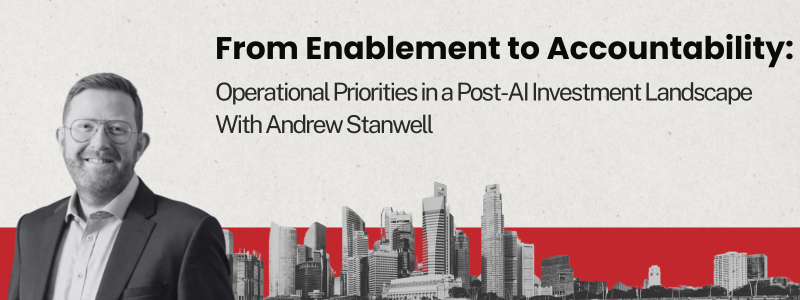
As investment operations undergo rapid transformation, few voices are better positioned to comment on its future than Andrew Stanwell. With a front-row seat to the intersection of data, regulation, and automation, Stanwell shares how his team is navigating the shift — not just to modernise, but to lead with integrity.
His perspective reflects a growing truth among operations leaders: in today’s climate, resilience is not just systems, but also about trust, governance, and clarity.
AI as an Enabler, Not a Replacement
Stanwell is clear about how Roc Partners approaches AI adoption. It’s not a matter of hype or headline-chasing but purposeful enablement.
“Our approach begins with identifying use cases that deliver measurable efficiency and insight — for example, automating meeting summaries and task extraction, streamlining data validation across administrator reports, and supporting due diligence and regulatory reviews through natural-language processing.”
The firm operates under a 'governed experimentation' model, where AI tools undergo review under their data governance and cybersecurity frameworks. This includes data residency, access control, and model transparency. Use of generative AI is limited to secure environments within the Microsoft 365 ecosystem or trusted vendors.
“Safeguards include classification tagging, prompt-level disclaimers, and human review for all investor-facing and regulatory outputs. The focus is on augmenting analytical capacity and freeing teams to focus on higher-value problem-solving, while maintaining accountability and auditability.”
Taming the Data Maze: Toward a Single Version of Truth
When asked about his biggest data challenge, Stanwell points to a familiar pain point for private-markets managers: unstructured data from fragmented systems.
“Each data source — from fund accounting to CRM to performance analytics — operates under different structures, quality thresholds, and update cycles.”
To address this, Roc Partners is exploring a structured Data Architecture and BI Foundations solution. At the core is a centralised data warehouse designed to consolidate fund, investor, and investment data. This effort is governed by clearly defined data dictionaries and ownership models that ensure consistency and accountability.
Stanwell explains that the firm is planning enhanced metadata management, real-time data-quality monitoring, and the use of AI-driven schema recognition to extract insights from unstructured GP reporting. The objective? A 'single version of truth' that not only supports internal analytics but will also power their new client portal to deliver clearer, more transparent reporting to investors.
Regulatory Pressure as a Catalyst for Operational Strength
Stanwell’s regulatory priorities for 2025 reflect a dual focus on Australian-specific reforms and global compliance obligations.
“Our focus remains on the continued evolution of APRA CPS 230, enhancements to ASIC RG 97, and the broader expectations surrounding operational resilience and fee transparency.”
To prepare, Roc Partners is reinforcing governance around third-party service providers and embedding continuity planning into outsourcing frameworks. At the same time, they are improving cost and performance disclosures, both at the fund and asset levels, to give investors a clearer view.
They are also strengthening compliance across jurisdictions, including FATCA/CRS, Cayman AML/CTF requirements, and emerging ESG data obligations, moves that will help the firm to stay ahead of shifting standards.
What’s Next: Governance Will Define Digital Success
Looking forward, Stanwell identifies a pressing challenge that could define the next phase of operational maturity:
“The biggest challenge will be balancing digital transformation with the maturity of data governance.”
He warns that the industry’s race to adopt automation, AI, and investor transparency tools will expose legacy processes and fragmented ownership structures, particularly in firms that haven’t invested in foundational data architecture.
“Operational leaders will need to rethink the role of the operations function — not as a cost centre, but as the custodian of data integrity and client trust.”
The message is clear: those who embed strong governance, interoperable systems, and human-in-the-loop safeguards will not only be more resilient.
They’ll be more competitive.
Are you interested to hear more leaders discuss the future of investment operations? The conversations continues at InvestOps - download the agenda to see who else is attending this year.